

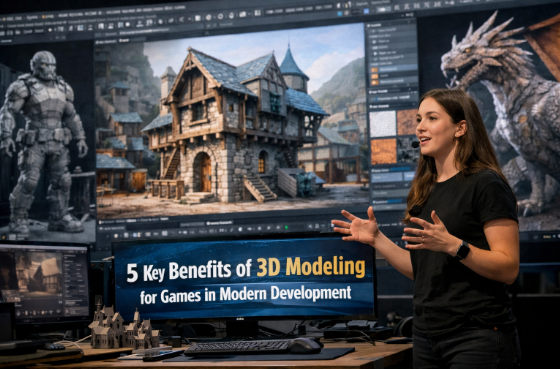
Today’s games are perceived for judging the sight, but also judging the feel. If you want an audience of players to draw them deep into their worlds, then a believable character must be in the platform-to-platform and smooth interactions.
At the core of such experiences, therefore, lies a 3D modeling for games, which has come to take center stage in developing the game rather than some side feature. Great 3D models improve rendering visuals and not only that, but also the dynamics of gameplay, emotional engagement, effectiveness, and even long-term retention of players.
This means that a clear understanding of what benefits 3D modeling gives studios the ability to make intelligent, creative, and technical decisions, even at the beginning of making a video game.
Creates Deeper Player Immersion
Immersion has nothing to do with this; it just drags you in and keeps you in this game. By high-standard and depth 3D modeling for games, it is possible for developers to build environments that feel really alive instead of staged.
Once characters start moving in realistic ways and react to objects that react naturally, the spaces have a believable depth and scale sense of reality, and players do not feel like observers anymore but acting participants. Good models really help blur the lines between gameplay and storytelling.
Because the players do not just see their world, they are really experiencing it. The sense of presence increases that emotional attachment and makes the whole experience far more memorable.
Enhances Visual Storytelling
Games are mostly dramatic visual cues that allow storytelling without interruption. 3D models allow silent narrative to play; an example of such a non-spoken storytelling is when the armor of a character tells what he has a history through the wear on his weapon or the decay in an environment.
Through 3D modeling, the artist embeds narrative elements into the assets, thus affecting organic storytelling in which players are supposed to derive meaning from the story via exploration rather than being alienated from it by ingesting it.
Improves Gameplay Mechanics and Interaction
To be fair, it takes much more than great visuals to build up a great gameplay experience. 3D models affect hitboxes, motion, physics, and even the way players can use the world. Smooth and responsive experiences result from having a clean topology and accurate proportions that meet expectations in the animation.
When models are thought out with gameplay in mind, suddenly a lot of intuitive things begin to happen, and combat suddenly makes far more sense. As such, 3D modeling for games creates a less frustrating, smoother overall game flow, created from analyzing what players see and what they can do.
Supports Multi-Platform Performance
Modern games are created not usually for only one platform, but developers simultaneously target PC, console, mobile, and even cloud gaming applications. Optimized 3D modeling achieves this goal. Good 3D assets with intelligent UV layouts and scalable assets allow devices to maintain the same level of performance without compromising the quality.
They also allow the team to develop adaptable assets that can further be adjusted for different hardware capabilities. 3D modeling transforms the game in such a way that it meets the cost of producing a valuable experience.
This means that even a single game can reach a much wider player base without compromising performance, which proves essential in today’s competitive market.
Speeds Up Development and Reduces Rework
Well-planned 3D modeling saves time through the entire production pipeline because 3D modeling is planned well upfront. Having clean assets built to the same standards means they will integrate with animation, lighting, and game engines more easily, reducing future technical difficulties that typically require last-minute fixes and delaying the launch.
Those who partner with an experienced 3D visualization company usually enjoy structured workflows and reuse asset libraries. This means faster iteration, smoother collaboration, and fewer costly alterations. Over the years, this has led to efficiencies in budget and delivery timelines.
Conclusion
Though many studies can be said specifically about 3D modeling for games, it does not only stop there but shapes immersion, storytelling, gameplay quality, performance, and even the efficiency of production. Strong 3D modeling is not merely an option in today’s game development; it is entirely foundational.
Intentionally creating assets with technical clarity thus elevates the entire experience for both the player and developer. Games with 3D modeling creativity not only get better in looks, but also play better, scale better, and become relevant longer.